 Poloniex
 withdrawals: Fees and Transfer Requirements
Updated -
Poloniex withdrawals require Advanced KYC Verification. An on-chain withdrawal moves crypto from a Poloniex balance to an external wallet or another exchange’s deposit address. On-chain withdrawals must be available for the selected asset and network, the receiving details must be correct, and the request must clear account authorization. Asset-specific fees affect the cost; blockchain inclusion and recipient crediting affect when the transfer becomes usable.
Withdrawal Fees and Minimum Amounts
Poloniex’s Fee Structure, last updated August 4, 2022, describes a fixed withdrawal charge per asset. It says charges can change with network congestion and other factors, and directs users to the currency’s entry in Wallets for the applicable amount. For an on-chain withdrawal, the amount must meet any minimum for the selected asset and network. Review the fee shown for the selected withdrawal before authorizing it.
Trading commissions and internal transfers have different fee scopes. A maker or taker rate applies to an executed trade. The same 2022 schedule described free Off-Chain Transfers between Poloniex accounts, which keep funds within Poloniex and don’t deliver coins to an external wallet. Under the July 15, 2026 withdrawal API upgrade, Poloniex also supports transfers of eligible assets to a linked HTX account without a handling fee; the API key must have withdrawal permission.
Address, Network, and Tag Requirements
The receiving wallet or exchange must accept the selected asset on the network used for the withdrawal. Use the destination’s deposit instructions for its address and any required tag or memo. If withdrawal whitelist mode is enabled, the destination address must be whitelisted before you can make an on-chain withdrawal. For an XRP transfer to a receiving exchange requiring a destination tag, include both its XRP deposit address and the supplied tag.
Poloniex’s ETH withdrawal instructions place address entry, amount entry, and network-fee review before authorization with two-factor authentication (2FA). Account authorization and blockchain confirmation are separate: approving the request doesn’t establish that the transaction has been included on-chain.
Account Restrictions and Reported Outcomes
An account security review can affect withdrawal processing independently of network congestion. For users whose KYC indicates Russian nationality, Poloniex announced an orderly service exit on October 28, 2026. The notice said withdrawals would remain open and left the retirement timetable for later announcements.
Poloniex’s Level 1 vs Level 2 Verification Features table lists a daily withdrawal cap of USD 500 000 for Level 2 accounts by default, rising to USD 1 000 000 with two-factor authentication (2FA). Its FAQs for Unverified Accounts says completing Advanced KYC Verification raises the daily cap to USD 1 000 000, without specifying whether 2FA is also required. These passages don’t establish whether the same 2FA condition applies to the Advanced KYC cap. Confirm the limit and required settings for your account with Poloniex support before planning withdrawals that depend on either figure.
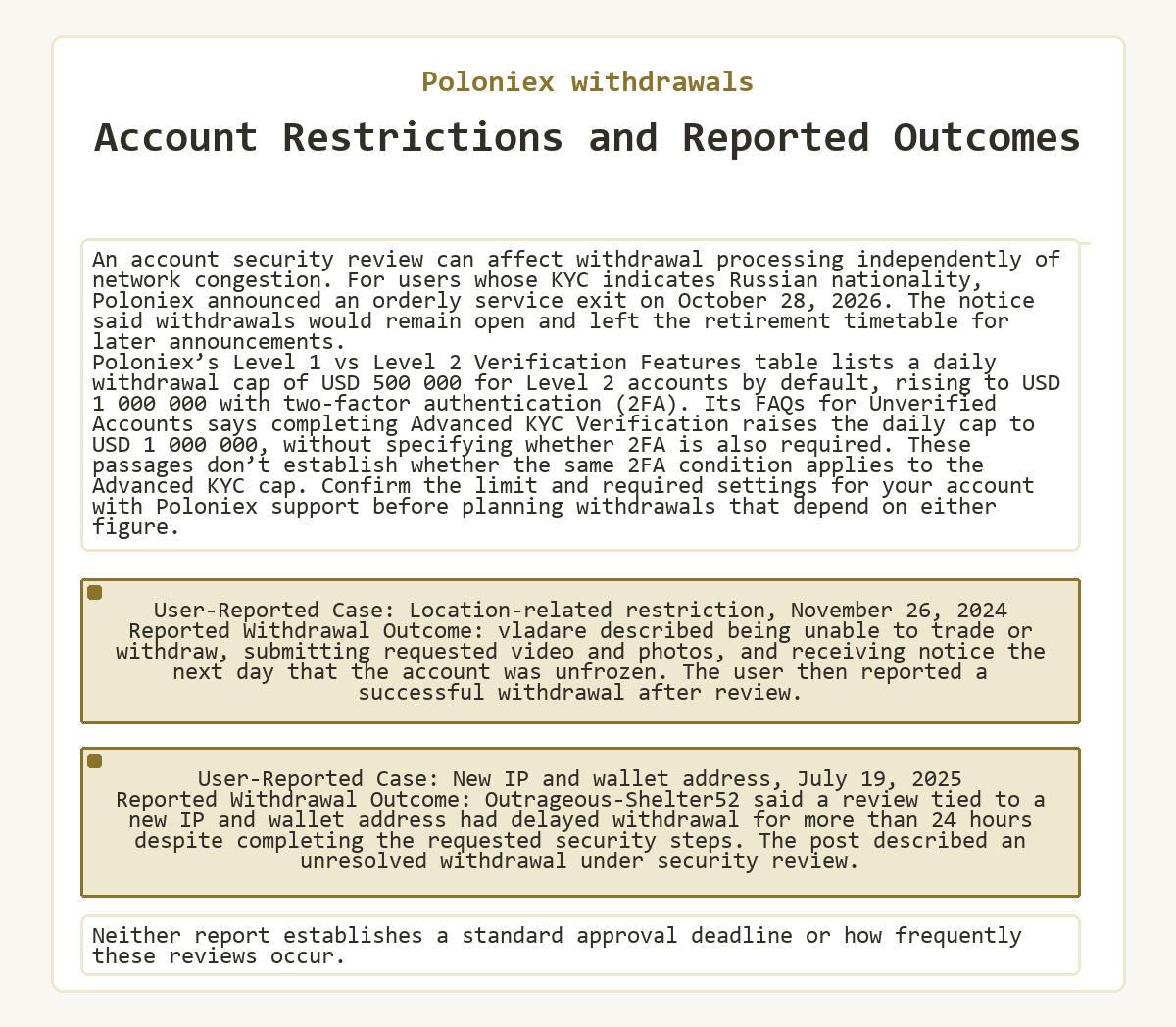
| User-Reported Case | Reported Withdrawal Outcome |
|---|---|
| Location-related restriction, November 26, 2024 | vladare described being unable to trade or withdraw, submitting requested video and photos, and receiving notice the next day that the account was unfrozen. The user then reported a successful withdrawal after review. |
| New IP and wallet address, July 19, 2025 | Outrageous-Shelter52 said a review tied to a new IP and wallet address had delayed withdrawal for more than 24 hours despite completing the requested security steps. The post described an unresolved withdrawal under security review. |
Neither report establishes a standard approval deadline or how frequently these reviews occur.
Wallet Pauses, Broadcasts, and Recipient Credit
An asset wallet under maintenance presents a different constraint from a review of one account. In nbom’s May 9, 2022 XMR post, reproduced support messages said the wallet was disabled with no estimated reopening time. Those messages concern that historical XMR pause; they don’t establish current withdrawal availability or the exchange’s holdings.
For SC, Taek42’s June 2, 2017 Sia transaction-pool explanation attributed many Poloniex withdrawal failures to full transaction pools discarding transactions before blockchain inclusion. The post described rebroadcasting after capacity became available, alongside transaction-pool improvements planned for a later release. The rebroadcasting remedy depended on the sending exchange using it.
A transaction ID or a completed label in exchange history doesn’t by itself establish receipt. Where the network exposes the relevant transaction record, an explorer can show whether the transaction reached the blockchain. A receiving exchange may still need to credit its customer account after confirmation. The 2017 Sia discussion also noted that an unsynchronized Sia wallet may not display incoming funds until it catches up.
For an on-chain withdrawal, a private support request should identify the asset, network, amount, destination details, request time, exact withdrawal status, and transaction ID if one exists. If the transaction can’t be found on the correct network, ask Poloniex to investigate its broadcast details. If an on-chain transfer matches the intended network and receiving address but another exchange hasn’t credited it, give that receiving exchange the transaction details for investigation.